







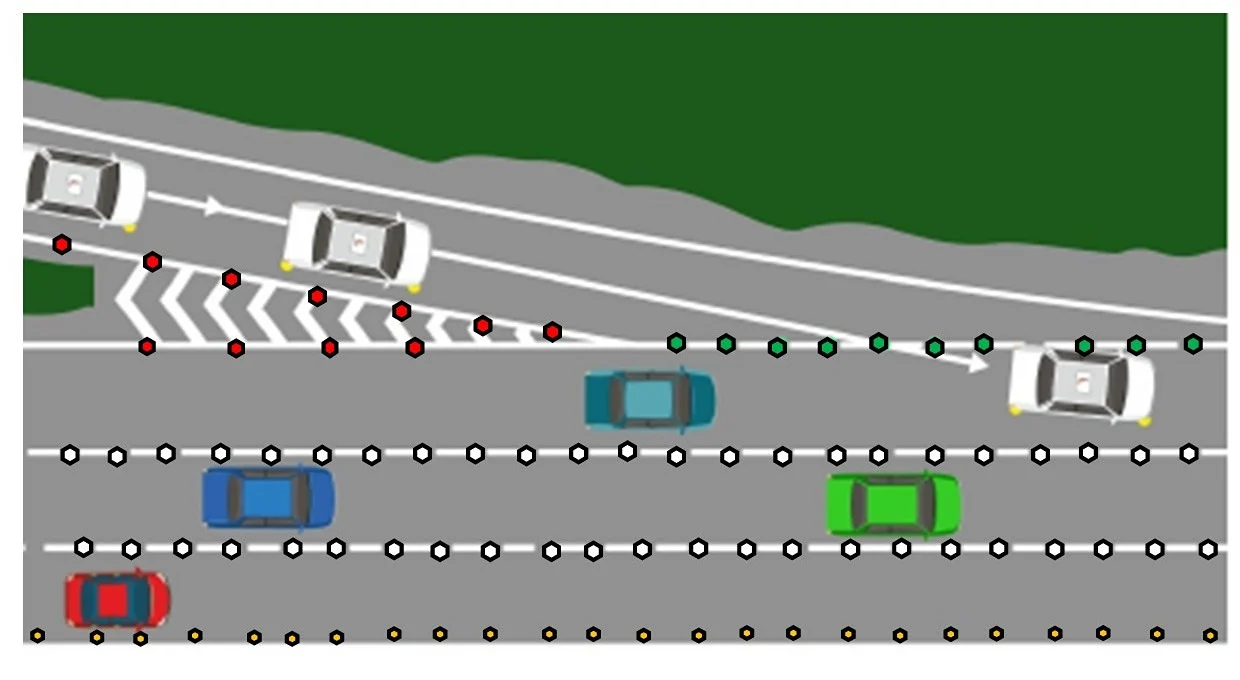
Amber reflective studs are an important visual feature on UK motorways and dual carriageways. They help drivers recognise the right-hand edge of the main carriageway, where it runs alongside the central reservation. Their reflective surfaces become visible when illuminated by vehicle headlights, making them particularly useful during darkness. Understanding their position and purpose can help motorists interpret the motorway layout more confidently and can also make common driving theory questions much easier to answer correctly.
For learner drivers, knowing the meaning of different motorway stud colours is an important part of understanding road markings and carriageway features. The key point is that amber reflective studs on motorway roads are normally associated with the central-reservation side. This makes them different from red studs beside the hard shoulder, white studs between lanes and green studs around slip roads. Once the layout is understood visually, remembering these differences becomes much simpler.
What Are Amber Reflective Studs?
Amber reflective studs are small road-mounted devices designed to provide visual guidance to drivers. They reflect light from approaching vehicle headlights, allowing important road boundaries to remain easier to identify after dark. They are commonly referred to as reflective road studs or, in some contexts, cat’s eyes. Their purpose is not to replace painted road markings or traffic signs but to provide another useful indication of the road layout.
On a normal UK motorway, amber studs are positioned along the right-hand edge of the main carriageway beside the central reservation. This location gives drivers a clear visual reference to the boundary separating the carriageway from the central part of the motorway. Because motorways carry traffic at relatively high speeds, having clear and recognisable road features can be especially helpful when visibility is reduced or when travelling at night.
Where Are Amber Reflective Studs Found on a Motorway?
The normal position of amber reflective studs is the right-hand edge of the main carriageway, next to the central reservation. When travelling in the usual direction on a UK motorway, the central reservation is generally on the driver’s right, while the hard shoulder is on the left. This makes the location of amber studs relatively easy to understand when the physical layout of the motorway is visualised.
A useful way to recognise their position is to imagine yourself travelling along a three-lane motorway. The white studs will generally appear between the traffic lanes, while the red studs are associated with the left-hand edge near the hard shoulder. On the opposite side, beside the central reservation, you can expect amber studs. This relationship between colour and position is particularly useful when revising for the driving theory test.
What Do Amber Reflective Studs Mean?
Amber reflective studs normally indicate the right-hand edge of the main carriageway beside the central reservation. They help drivers recognise where the usable carriageway ends on that side of the road. This can be particularly valuable after dark because the reflective surface catches the light from headlights and creates a visible reference point along the edge.
It is important not to confuse amber studs with lane separators. White reflective studs are normally positioned between lanes travelling in the same direction, while amber studs identify the outer edge of the carriageway on the central-reservation side. Understanding this distinction helps drivers interpret the road layout more accurately and reduces the likelihood of confusing different stud colours during a theory test.
Motorway Reflective Stud Colours Explained
Different colours of reflective studs are used to provide different information about the motorway layout. Amber studs are associated with the right-hand edge beside the central reservation, while red studs normally identify the left-hand edge beside the hard shoulder. White studs are used between lanes travelling in the same direction, helping drivers distinguish one traffic lane from another.
Green studs have a different role and are generally associated with slip roads and areas where vehicles enter or leave the main carriageway. Temporary traffic arrangements may also introduce additional markings or fluorescent colours around roadworks. The easiest way to remember the permanent colours is to connect each one with a physical part of the road rather than trying to memorise a list without understanding the layout.
Amber and Red Reflective Studs: What Is the Difference?
Amber and red studs are frequently confused because both are used along the outer edges of the main carriageway. The important difference is their position. Amber studs normally identify the right-hand edge beside the central reservation, whereas red studs generally identify the left-hand edge beside the hard shoulder. This distinction is especially important for learners because it is a common subject in motorway theory-test revision.
One of the simplest ways to remember the difference is to picture yourself driving forward on a motorway. The central reservation should normally be on your right and the hard shoulder on your left. Amber belongs to the central-reservation side, while red belongs to the hard-shoulder side. Using the physical road layout as a memory aid is usually more reliable than attempting to remember the colours in isolation.
How to Remember Motorway Stud Colours
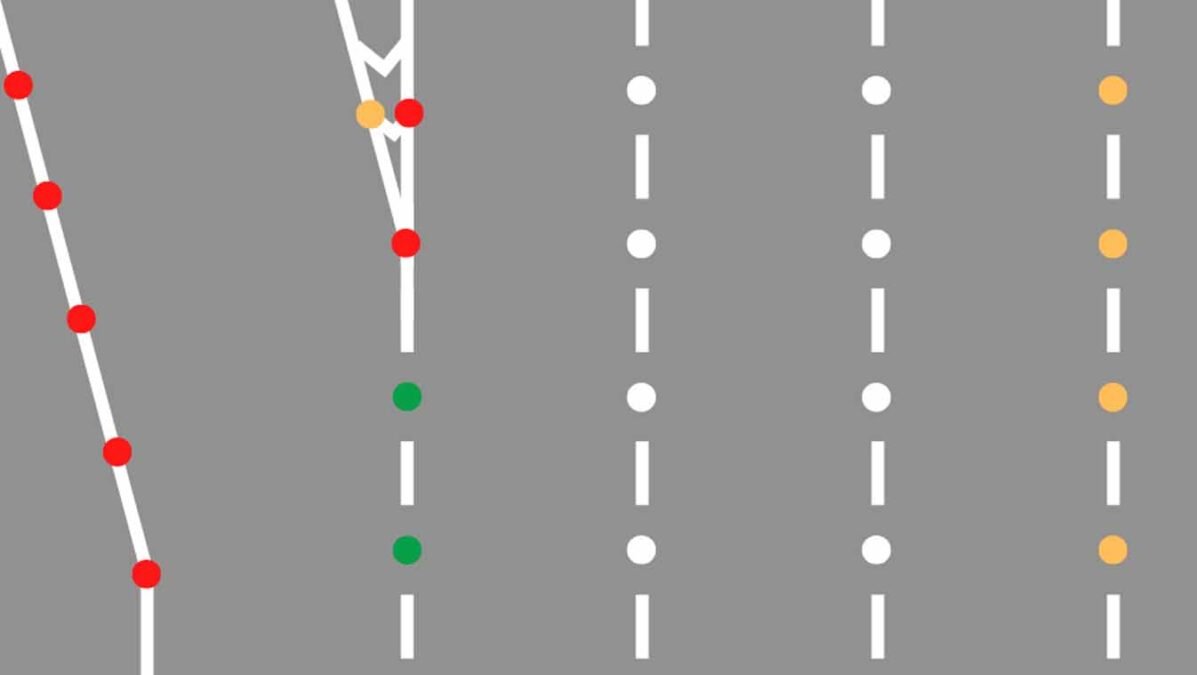
A practical memory technique is to visualise a motorway from the driver’s perspective. Start with the two outer edges: amber is on the right beside the central reservation, while red is on the left beside the hard shoulder. Then remember that white studs separate the lanes in between. Green studs can be linked with slip roads because they identify areas where vehicles join or leave the main carriageway.
This approach creates a simple mental map rather than a collection of disconnected facts. A quick revision table can also reinforce the information: amber means the central-reservation side, red means the hard-shoulder side, white means lane separation and green is associated with slip roads. Understanding why each colour is positioned where it is can make theory-test revision considerably easier.
Why Are Amber Reflective Studs Important at Night?
Reflective studs become particularly useful after sunset because their surfaces can reflect vehicle headlights back towards the driver. On an unlit section of motorway, this can provide a visible indication of the carriageway boundary even when other features are difficult to see. Their reflective quality can therefore contribute to a clearer understanding of the road ahead.
Their usefulness can become even more noticeable during poor weather. Rain, spray, fog and darkness can make road markings and surrounding features harder to distinguish. Reflective studs provide an additional visual reference, but they should never be treated as the only source of information. Drivers must continue to observe signs, lane markings, traffic conditions and changes in the road environment.
Amber Reflective Studs and the Central Reservation
The central reservation separates opposing carriageways on a motorway or dual carriageway. Because traffic travelling in the opposite direction is separated from your carriageway, the boundary beside the central reservation needs to remain clearly identifiable. Amber studs help provide this visual indication along the right-hand edge of the carriageway.
When travelling at night, the reflective studs can help reinforce the driver’s understanding of where the carriageway boundary is located. However, they do not give drivers permission to cross or move beyond that boundary. Drivers should always follow road markings, signs, barriers and current traffic-management arrangements. Temporary roadworks can alter normal layouts, so the information visible on the road at the time should always take priority.
Common Mistakes About Amber Reflective Studs
One of the most common mistakes is assuming that amber studs are found beside the hard shoulder. This is incorrect for the normal motorway arrangement. The hard shoulder is generally on the left and is associated with red reflective studs, while amber studs are positioned on the right-hand side beside the central reservation. Remembering these two boundaries together can prevent a common theory-test error.
Another mistake is confusing amber studs with white lane studs. White studs generally separate lanes travelling in the same direction, so they do not mark the outer edge of the motorway. Green studs can also cause confusion because they are associated with slip roads and areas where traffic joins or leaves the main carriageway. Learning the purpose of each colour makes these distinctions much easier.
Amber Reflective Studs and the Driving Theory Test
Reflective studs are a useful topic for learner drivers preparing for the UK driving theory test because questions can test both their colour and their location. A question may ask where a particular colour is normally found, or it may present a road situation and require the correct stud colour to be identified. Understanding the motorway layout makes these questions easier than relying on guesswork.
If a question asks about amber reflective studs on motorway roads, think about the central reservation first. Amber is associated with the right-hand edge of the main carriageway beside that reservation. Red is associated with the hard-shoulder side, white separates lanes and green is generally linked with slip-road areas. This simple mental picture can help learners reach the correct answer more confidently.
How to Identify Amber Studs While Driving
When driving on a motorway, the first step is to understand your direction of travel and identify the central reservation. The edge of your carriageway alongside that reservation is the area where amber studs are normally located. At night, they may be particularly noticeable when illuminated by your headlights, providing an additional visual reference for the carriageway boundary.
Drivers should not focus excessively on individual studs while travelling at motorway speeds. They are only one part of the overall road environment. Safe observation should include the traffic ahead, mirrors, signs, lane markings, speed limits, roadworks and changing conditions. Reflective studs are there to support road awareness rather than become the sole focus of a driver’s attention.
Are Amber Reflective Studs the Same as Cat’s Eyes?
The term “cat’s eyes” is commonly used when people talk about reflective road studs. Traditional cat’s-eye devices and modern reflective studs have a similar broad purpose: helping drivers identify road features and boundaries, particularly when visibility is limited. Different terminology may be used depending on the context, but the important information for drivers remains the colour, position and function of the road stud.
For theory-test preparation, there is little benefit in becoming overly concerned about the terminology. If a question refers to amber studs or reflective cat’s eyes, focus on the road layout. Amber normally indicates the right-hand edge beside the central reservation. Knowing this relationship is more useful than simply memorising the name of the device.
Safety Tips When Driving Near Motorway Edges
Drivers should maintain a safe and stable position within their lane and avoid drifting towards the central reservation. Maintaining an appropriate speed and leaving sufficient distance from vehicles ahead gives you more time to react to unexpected changes. Reflective studs can help identify the carriageway boundary, but they should always be considered alongside road markings, signs and the wider traffic environment.
Extra care is necessary during darkness, heavy rain, fog, spray, congestion and roadworks. Temporary traffic-management systems can change the normal appearance of a motorway, including lane arrangements and road boundaries. When this happens, drivers should follow the temporary signs and markings displayed on the road. Good observation and appropriate speed remain essential regardless of how clearly reflective studs are visible.
Frequently Asked Questions About Amber Reflective Studs
Where are amber reflective studs found on a motorway?
Amber reflective studs are normally found along the right-hand edge of the main carriageway beside the central reservation. They help identify this boundary and can provide useful visual guidance, particularly after dark when their reflective surfaces are illuminated by vehicle headlights. Their position is different from red studs beside the hard shoulder and white studs between traffic lanes.
What do amber reflective studs mean?
Amber reflective studs normally indicate the right-hand edge of the main carriageway beside the central reservation. They are designed to provide a visual reference for that boundary rather than separate individual traffic lanes. Understanding this distinction is important for both practical motorway awareness and driving theory-test preparation.
Are amber reflective studs on the left or right?
Amber reflective studs are normally found on the right-hand edge of the carriageway when travelling in the usual direction on a UK motorway. This is the side associated with the central reservation. Red studs are generally found on the opposite side near the hard shoulder, which provides a useful way to remember the difference.
What colour studs are found next to the hard shoulder?
Red reflective studs normally mark the left-hand edge of a motorway beside the hard shoulder. Remembering red for the hard-shoulder side and amber for the central-reservation side creates a simple mental picture of the motorway. This can be particularly helpful when answering road-stud questions during theory-test revision.
What colour reflective studs separate motorway lanes?
White reflective studs are generally used between lanes travelling in the same direction. Unlike amber and red studs, which normally identify the outer edges of the carriageway, white studs help distinguish individual traffic lanes. This makes their purpose relatively easy to remember once the basic motorway layout is understood.
What colour studs mark motorway slip roads?
Green reflective studs are generally associated with slip roads and areas where vehicles enter or leave the main carriageway. They help drivers recognise changes in the road layout. However, motorists should always follow the signs, road markings and traffic-management arrangements present at the time rather than relying on studs alone.
Are amber reflective studs used on dual carriageways?
Amber studs can also be used on dual carriageways to identify the right-hand edge beside the central reservation. The key principle is their relationship with the central-reservation side of the carriageway. Understanding this makes it easier to apply the same basic colour system beyond motorways.
Why are motorway studs different colours?
Motorway studs use different colours to help drivers distinguish between important parts of the road layout. Amber is associated with the central-reservation side, red with the hard-shoulder side, white with lane separation and green with slip-road areas. The colour system provides quick visual information that complements other road markings and signs.
Are amber reflective studs important for the driving theory test?
Yes, understanding reflective stud colours is useful for theory-test preparation. Questions can ask learners to identify where a particular colour is found or what it represents. Instead of memorising individual answers, it is better to understand the physical motorway layout so the correct answer can be worked out logically.
How can I remember the meaning of amber motorway studs?
The easiest approach is to picture yourself travelling forward on a motorway. The central reservation is normally on your right, so amber belongs to that side. Red is associated with the hard shoulder on the left, white separates lanes and green is associated with slip-road areas. This visual method makes revision easier.
Conclusion
Amber reflective studs provide an important visual reference along the right-hand edge of a motorway or dual carriageway, beside the central reservation. Their reflective surfaces can make the boundary easier to identify at night and in reduced visibility. They work alongside road markings, traffic signs and other road features to help drivers understand the layout without replacing the need for careful observation.
The most important fact to remember is that amber reflective studs on motorway roads normally indicate the central-reservation side, while red studs are associated with the hard-shoulder side, white studs separate lanes and green studs are linked with slip-road areas. For learner drivers, understanding this simple system can make theory-test revision easier and provide useful knowledge for safer motorway driving.
You may also read What Is PO Box 6887 Coventry?